The Intelligence Layer Has Arrived in Architecture
Revit gains a built-in co-pilot. MCP crosses 97 million downloads. And 40 companies are racing to reshape how buildings get designed and built.
Three signals arrived nearly simultaneously this spring and together they tell a coherent story: the AI layer in AEC is no longer coming. It's here, it's consolidating, and the firms that treat it as optional are already behind.
97M+ MCP monthly SDK downloads as of March 2026
87% of contractors believe AI will transform their business
19% of contractors have actually adapted their workflows
Revit 2026's AI assistant | What actually shipped
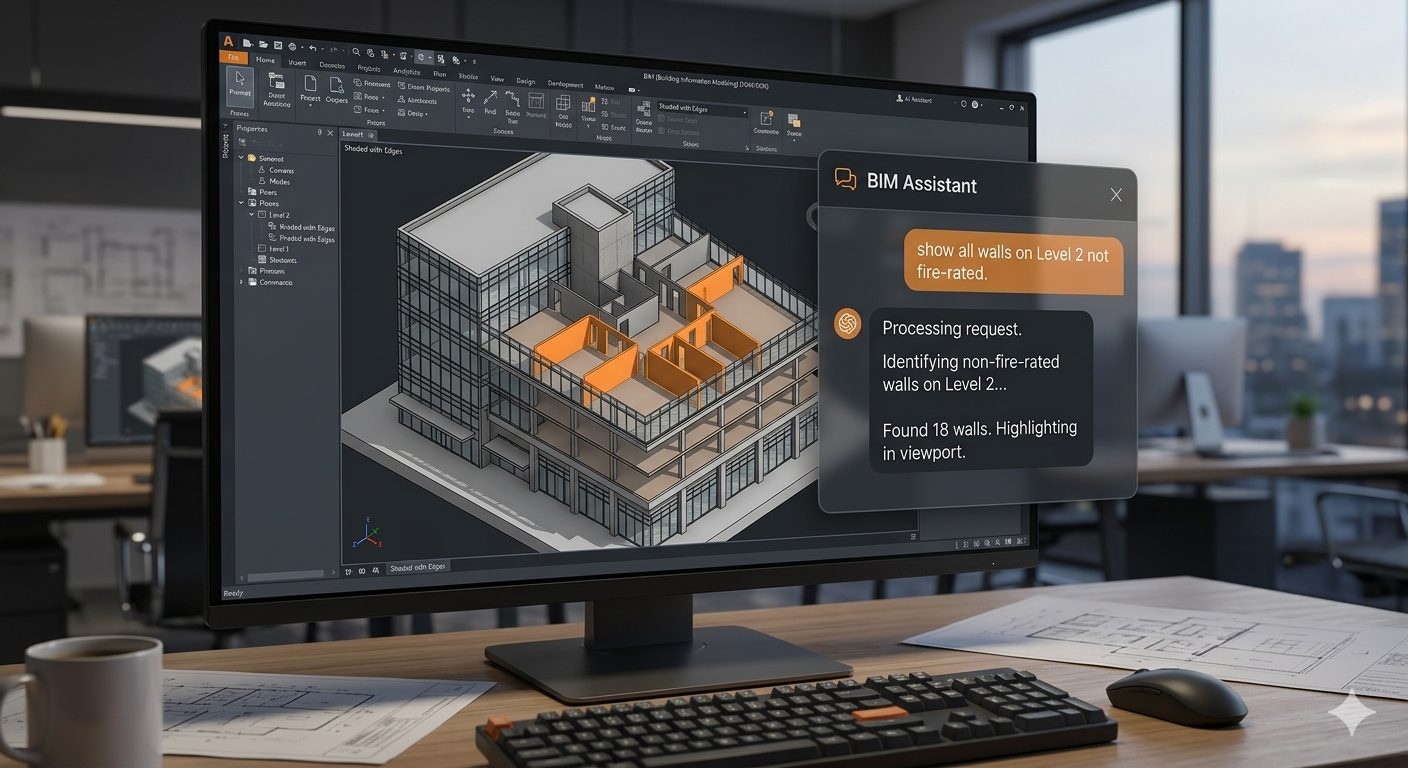
Autodesk's new Revit 2026 includes the Autodesk Assistant: a context-aware chat panel that lets users query their open project in plain language, navigate to views, and select elements by description. It's real, it works, and it meaningfully lowers the learning curve for new users.
But precision matters here. What shipped is a support and light-command layer — not a full agentic BIM co-pilot. The more capable task-execution version was announced at Autodesk University 2025, with no confirmed release date at the time of writing.
The gap between what Autodesk announced and what shipped is exactly where the third-party ecosystem is operating and moving faster.
Three tools have emerged as production-relevant for architects today:
BIMLOGIQ Copilot
GPT-4–powered natural language execution inside Revit. Renames worksets, creates views, reads/writes Excel. 30-day free trial.
Glyph by EvolveLab
Documentation automation — sheets, tags, dimensions — via chat or voice. Long-standing plugin with AI layer added.
ArchiLabs Studio Mode
Browser-based, no install. Agent Mode queries the model then acts. Claims 10× documentation speed.
The productivity logic is sound: architects spend more than half of a project's timeline on construction documents. If AI can reclaim even a fraction of that time, the ROI is immediate. The 10× speed claims should be benchmarked independently — but the direction of the effect is real.
MCP: the protocol that will rewire AEC workflows
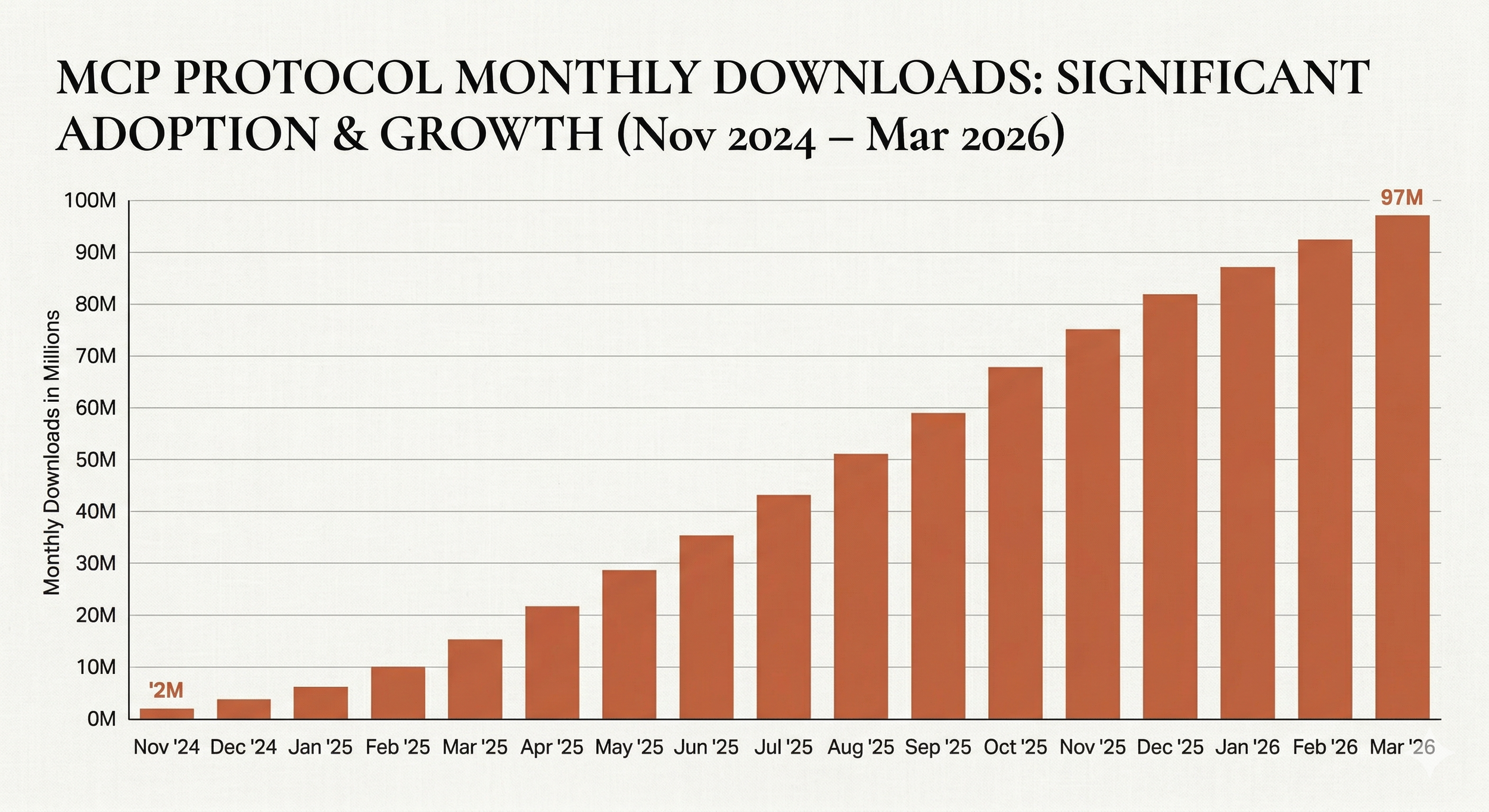
Model Context Protocol; an open standard created by Anthropic in November 2024 — just crossed 97 million monthly downloads. For context: React took three years to reach 100 million. MCP did it in 16 months, with every major AI provider aligned immediately.
The growth curve tells the adoption story cleanly:
What is it? Think USB-C for AI: a universal connector that lets any AI agent talk to any tool without custom integration code. Before MCP, connecting an AI to 10 business systems required 10 custom integrations. With MCP, each tool gets built once and works with every compliant AI client — Claude, GPT-4, Gemini, Copilot, all of them.
In December 2025, Anthropic donated MCP to the Linux Foundation under the new Agentic AI Foundation co-founded with OpenAI and Block, backed by AWS, Google, Microsoft, Cloudflare, and Bloomberg. This is infrastructure-level governance. MCP is not a trend. It is becoming the protocol layer of agentic AI.
For AEC specifically, the white space is wide open. No dominant AEC-specific MCP server has emerged yet. The practical upside: an AI agent that reads a Revit schedule, pulls RFI history from Procore, cross-references specs in a cloud drive, and drafts a response — in a single conversation, through one protocol.
One caveat worth stating plainly: security hardening has lagged adoption. Between January and February 2026, researchers filed over 30 CVEs targeting MCP implementations. Firms handling sensitive project data should evaluate carefully before deploying MCP-connected agents.
BuiltWorlds' 40 AEC AI companies | the signal beneath the list
BuiltWorlds published its "40 AI-Driven AEC Solutions to Watch in 2026" in January, covering the full project lifecycle from preconstruction through field operations. What's notable isn't any single company — it's the pattern.
The most funded category: preconstruction. AI is landing hardest where the data is clearest — drawings, specs, contracts, quantities. Companies like Document Crunch ($37M raised), Beam AI (formerly Attentive.ai, $48M raised), and Boon ($25.5M) are building agents that embed directly into the workflows estimators and PMs already run.
The macro context: in Q2 2025 alone, 68% of the $3.96 billion invested in built environment tech went to AI/ML companies. AECOM spent $390 million acquiring Norwegian AI startup Consigli — the clearest signal yet that incumbents are choosing to buy AI capability rather than build it.
87% of contractors believe AI will transform their business. Only 19% have adapted their workflows. That gap is the opportunity — and the audience.
The companies dominating this list share one trait: they solve a specific, painful, high-frequency problem — not AI-in-general. Drawer AI does electrical takeoffs from PDFs. Firmus detects design risks and scope gaps before bid day. Articulate auto-generates RFIs from drawing analysis. Narrow, deep, and immediately billable to a project.
The takeaway for architects: the list of 40 is less important than understanding the pattern it represents. AI is entering AEC through the most data-rich, cost-sensitive, document-heavy workflows first. Everything else follows.